OntoCraft
Solutions · OntoFactory

OntoFactory

A manufacturing knowledge AI service that structures equipment, process, quality, work and production data to support predictive maintenance, quality prediction, production optimization and SOP automation.

Manufacturing · Smart Factory · Predictive Maintenance

OntoFactory connects fragmented manufacturing data to raise equipment reliability, quality prediction and production decision quality.

Knowledge graph structure

Connecting manufacturing knowledge
around the process

Linking equipment, process, quality and work data by relationships to sharpen root-cause analysis and decision quality on the shop floor.

EquipmentProcessSensorWork conditionOperatorProduction planMaintenance logDefect historyQuality checkManufacturinggraph

Problems we solve

The data exists,
but it isn't connected

01

Equipment–quality gap

Equipment and quality data live apart, making causes hard to link.

02

Experience-bound analysis

Defect root-cause analysis relies on skilled workers' experience.

03

Reactive maintenance

Equipment failures are managed reactively, so prevention is hard.

04

Data stuck in dashboards

Smart-factory data stays at a view-only dashboard level.

05

Plan–floor disconnect

Production plans and shop-floor execution data are not connected.

Core services

Manufacturing knowledge
as executable AI

On ontology-structured manufacturing knowledge, we deliver predictive maintenance, quality prediction and a floor copilot.

Process ontology build

Define equipment, process, quality and work concepts and relationships as a knowledge graph.

Predictive maintenance model

Predict failures ahead of time from sensor and maintenance history.

Quality anomaly prediction

Detect anomalies early through the relationship of process variables and outcomes.

Defect root-cause GraphRAG

Trace the root-cause process and equipment through multi-hop reasoning.

Production KPI dashboard

Present uptime, defect rate and production trends with causes and evidence.

Work standard · SOP AI

Structure work standards and SOPs to answer floor questions precisely.

Shop-floor AI copilot

Answer operators' natural-language questions grounded in the knowledge graph.

Expected impact

From equipment reliability
to production decisions

Failure prevention

Shift from reactive to preventive.

Lower defect rate

Cut recurrence with cause-based analysis.

Higher productivity

Optimize flow across process, plan and floor.

Better decisions

Speed up judgment with grounded insight.

Plant floor tools

Reading drawing connections and
maintenance failures as a graph

OntoPlant

P&ID connection checks

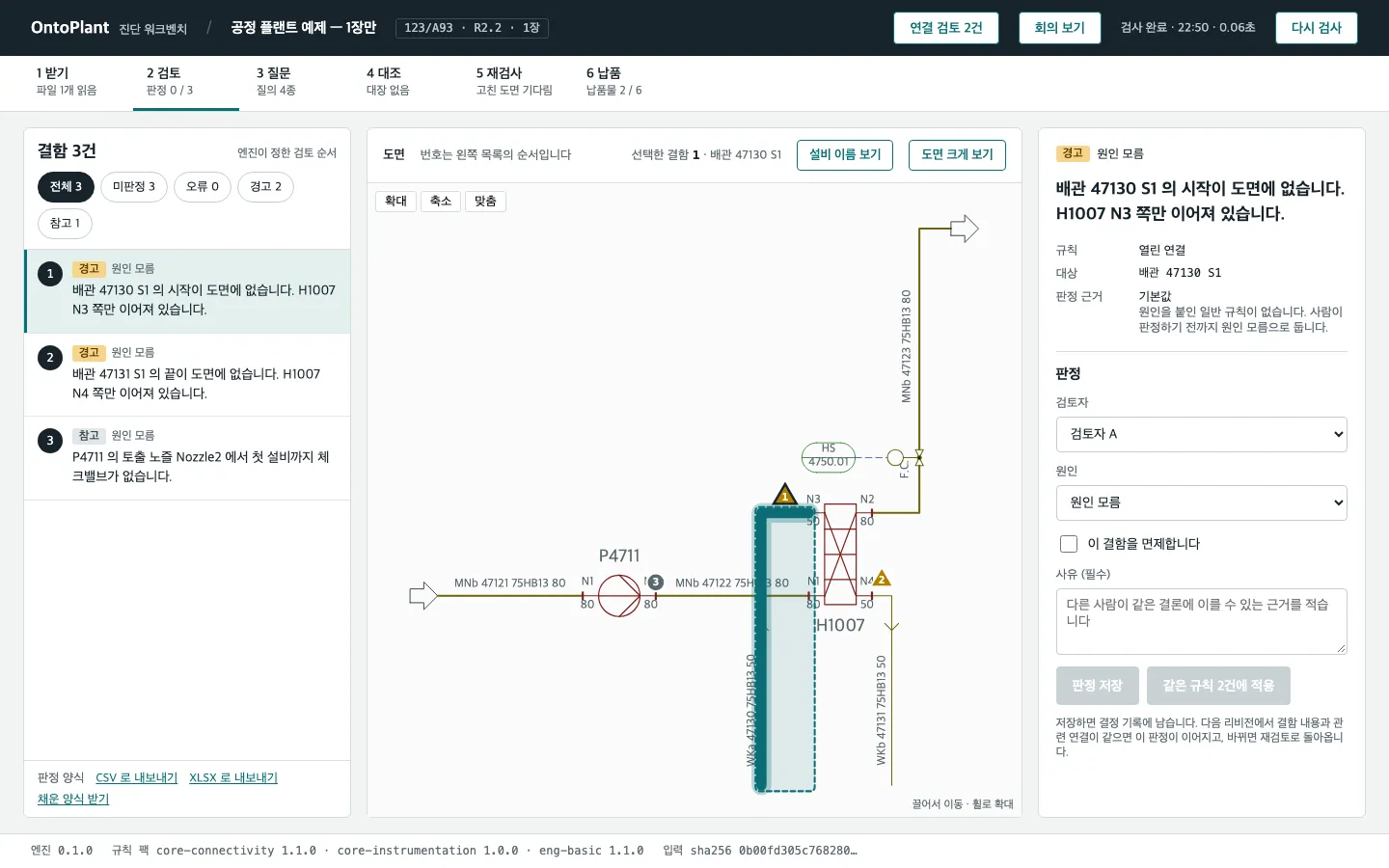
Turns P&ID drawings into a plant knowledge graph and checks whether the piping actually connects. It finds broken connections and empty nozzles and reports each with a severity and a cause. On the public DEXPI example drawing it found 4 connections without both ends attached.
ontoFMEA

Maintenance failure analysis

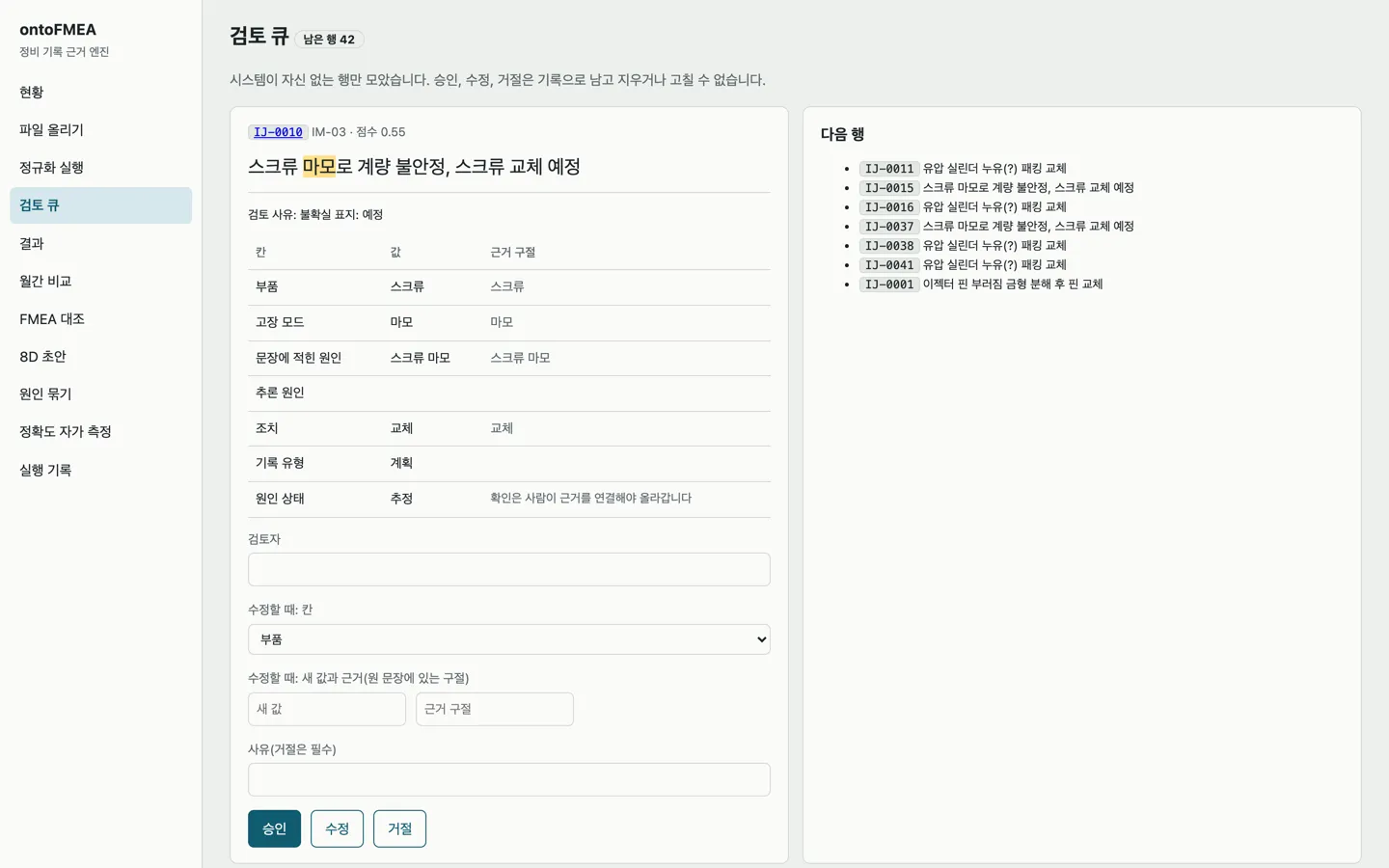
Normalizes free-text maintenance records into failure modes, causes, actions and parts. It ranks which failures stopped each piece of equipment, how often and for how long, and drafts an FMEA.

OntoPlant screens

It finds broken connections in a P&ID drawing, marks them on the drawing, and a person makes the call.

Defect review. The 3 defects the engine found are listed in review order, and their positions are numbered on the drawing. The reviewer picks a cause and records a decision.

The drawing is the DEXPI 2.0.1 specification reference drawing (DEXPI e.V., CC BY 4.0), split for the demo. It is not a customer or plant drawing. The app screens are in Korean.

See each finding on the drawing

The 3 defects the engine found are listed in review order, and their positions are numbered on the drawing. The reviewer picks a cause and records a decision.

1 / 4

ontoFMEA screens

It turns maintenance records that each person wrote differently into the same words, and shows which failures repeated and how often.

Review queue. Shows the original sentence, the normalized values and the phrase each value came from side by side. The reviewer approves, corrects or rejects.

Screens with synthetic example data. The numbers come from 42 example injection molding maintenance records, not from a real plant. The app screens are in Korean.

Every value has evidence, and a person checks it

Shows the original sentence, the normalized values and the phrase each value came from side by side. The reviewer approves, corrects or rejects.

1 / 4

To review it with your own drawings or maintenance records, let us know.

Contact us

Turn your shop-floor knowledge
into executable AI